Global NCAP brings vehicle safety to forefront of UN road safety meeting
Global NCAP is proud to have brought vehicle safety standards to the forefront of the conversation at the UN’s interactive multi-stakeholder hearing on road safety.
Held in advance of the UN High-Level Meeting which will take place this July, the hearing brought together Member States and UN agencies, NGOs, academics, road crash victims, youth representatives, philanthropic organisations and private sector stakeholders to discuss how to accelerate progress towards the global goal of halving road traffic deaths and serious injuries by 2030.
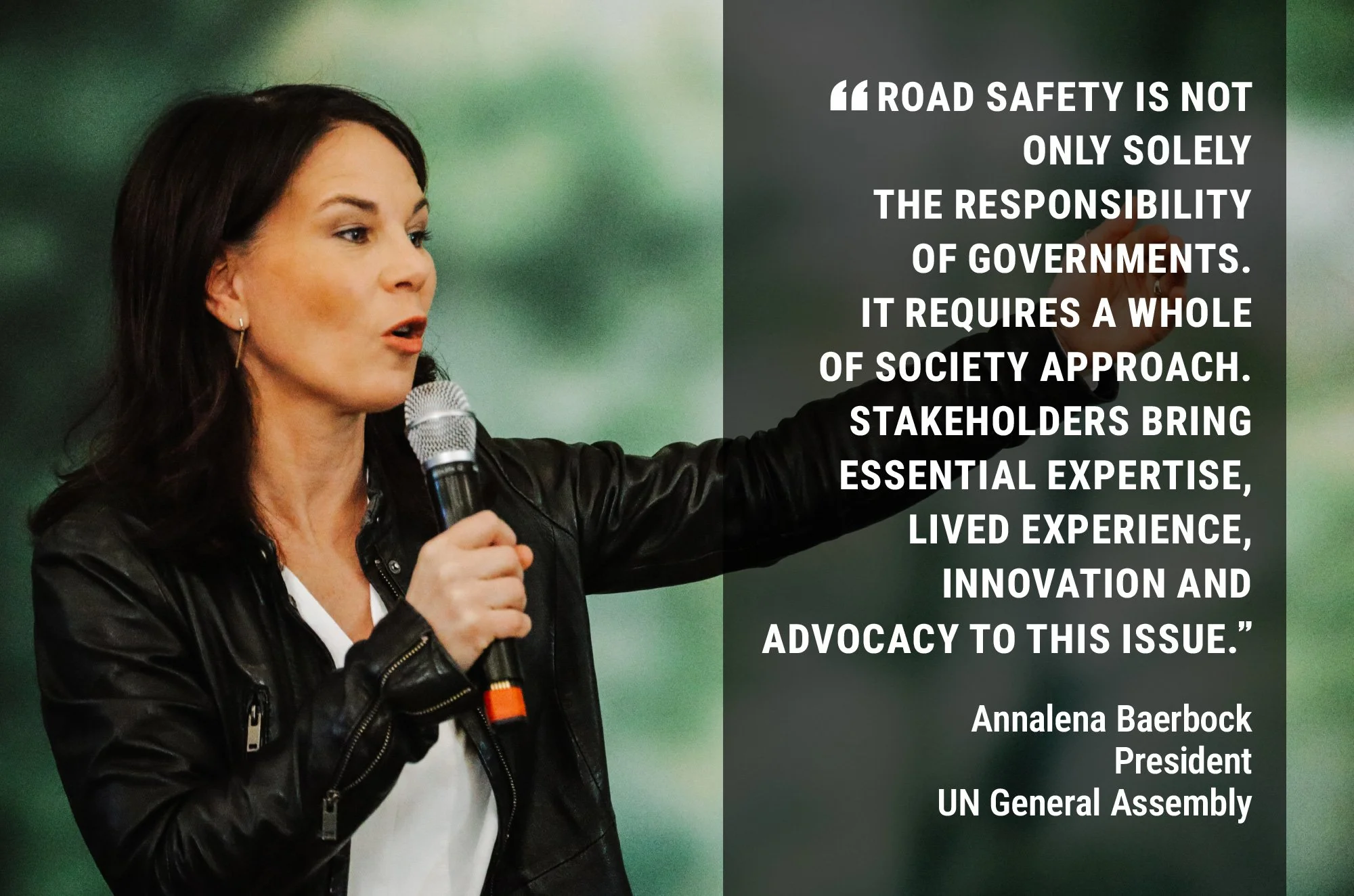
“Road safety is not only solely the responsibility of governments,” President of the UN General Assembly Annalena Baerbock said, opening the session.
“It requires a whole of society approach. Stakeholders bring essential expertise, lived experience, innovation and advocacy to this issue. They help strengthen the evidence base that informs policymaking while also playing a critical role in implementing solutions on the ground.”
“Today’s multi-stakeholder meeting is therefore a vital part of the preparatory process for the High-Level Meeting we are having on the 20th and 21st of July.”
Road safety remains a public health crisis with 1.2 million people killed in road crashes every year. While deaths have fallen by around 5% since 2010, progress remains far below the pace needed to meet the global target of halving road deaths and serious injuries by 2030.
Over 90% of road traffic deaths occur in low and middle-income countries and crashes remain the leading cause of death among children and young people aged between five and 29 years.
Highlighting road safety’s standing at the intersection of the UN’s three foundational pillars, Baerbock said: “It’s a matter of human wellbeing and security. It’s an economic issue given the immense social and financial cost. And it’s linked to sustainability through safer, cleaner and more accessible transport systems.”
“Dear excellencies, dear stakeholders, today’s hearings reflect the United Nations at its best.”
Baerbock’s opening was followed by remarks from WHO Director-General Tedros Adhanom Ghebreyesus, UN Special Envoy for Road Safety Jean Todt and road safety campaigner Viviam Perrone who recounted the death of her 14-year-old son after a speeding driver ran a red light in Buenos Aires.
“My daughter was only 3. My other son 16. Both struggled immensely to move forward with their lives,” Perrone told the hearing.
“My husband, at age 50, died of a fatal heart attack just one week before the trial began. My two children had lost their brother and father. So we’re not just discussing the loss of 1.2 million lives every year. We’re talking about the never-ending ripples of devastation.”
Rapid motorisation a “weapon of mass destruction”
Representing Global NCAP, President Emeritus David Ward addressed the hearing by painting a picture of the rapid motorisation the world is experiencing today.
More than two billion automobiles and one billion motorcycles were produced during the first quarter of the 21st century. “That is more than in the whole of the previous century,” Ward said.
The economic and social benefits brought by motorisation is undisputable. But Ward also warned of the human cost.
“The worldwide wave of motorised development has also proved to be a weapon of mass destruction,” he said, with more than 30 million lives claimed by road crashes in the past 25 years alone.
“If all the vehicles over those last 25 years had met best practice in vehicle standards, you could probably cut that number by between 25 and 30%. That gives you the scale of the improvement that the vehicle part of the story could contribute.”
21st century success so far
Ward highlighted significant advances in vehicle safety over the last 25 years, pointing to the global expansion of UN vehicle safety regulations and the role played by independent New Car Assessment Programmes (NCAPs).
“This combination of ‘regulatory push’ and ‘demand pull’ has ensured that today the most important UN crash test standards are now applied to over 95% of new passenger cars sold worldwide,” he said.
He added that Electronic Stability Control (ESC), widely regarded as one of the most effective crash avoidance technologies for passenger vehicles, is now fitted in around 80% of new cars globally.
“That has cost governments nothing. Zero. All of that progress is the relationship between the manufacturer and the consumer.”
G20 countries urged to lead
Implementation gaps, however, remain and Ward called on G20 countries - which account for around 90% of global motor vehicle production - to lead the way forward.
“They are the engine of all the vehicles that are populating the roads of the world,” he said. “Unfortunately, quite a number of G20 countries still do not apply the minimum recommended UN standards.”
He cited motorcycle anti-lock braking systems (ABS) as an example of a proven and affordable life-saving technology that remains underused, fitted to around 20% of motorcycles produced worldwide.
“It’s just scandalous frankly that a technology that is ubiquitous in four-wheeled vehicles is not also the same for motorcycles. And that is a government failure.”
Ward also warned against weakening existing safety standards amid ongoing trade disputes. He noted that while most major vehicle-producing countries apply UN pedestrian protection regulations, the United States does not and pressure is growing to relax standards to allow greater market access for non-compliant vehicles.
“This is unacceptable. US manufacturers should level up to global standards rather than drag them down.”
Looking ahead, Ward called on G20 nations to recognise their unique responsibility to ensure that all vehicles produced over the next 25 years comply with minimum UN safety regulations in the Global Plan.
“If the G20 accepted this responsibility, they would help answer the question: what are the next three billion vehicles in the fleet going to look like?”
Ending on a paradox that he believes should underpin the next phase of mobility, Ward said: “Of this new cohort of vehicles, we need them to be better than ever before and we need to use them a lot less.”