Women in Safety with Natalie Draisin: “We have more work to do, but we’ve secured a global movement to build upon”
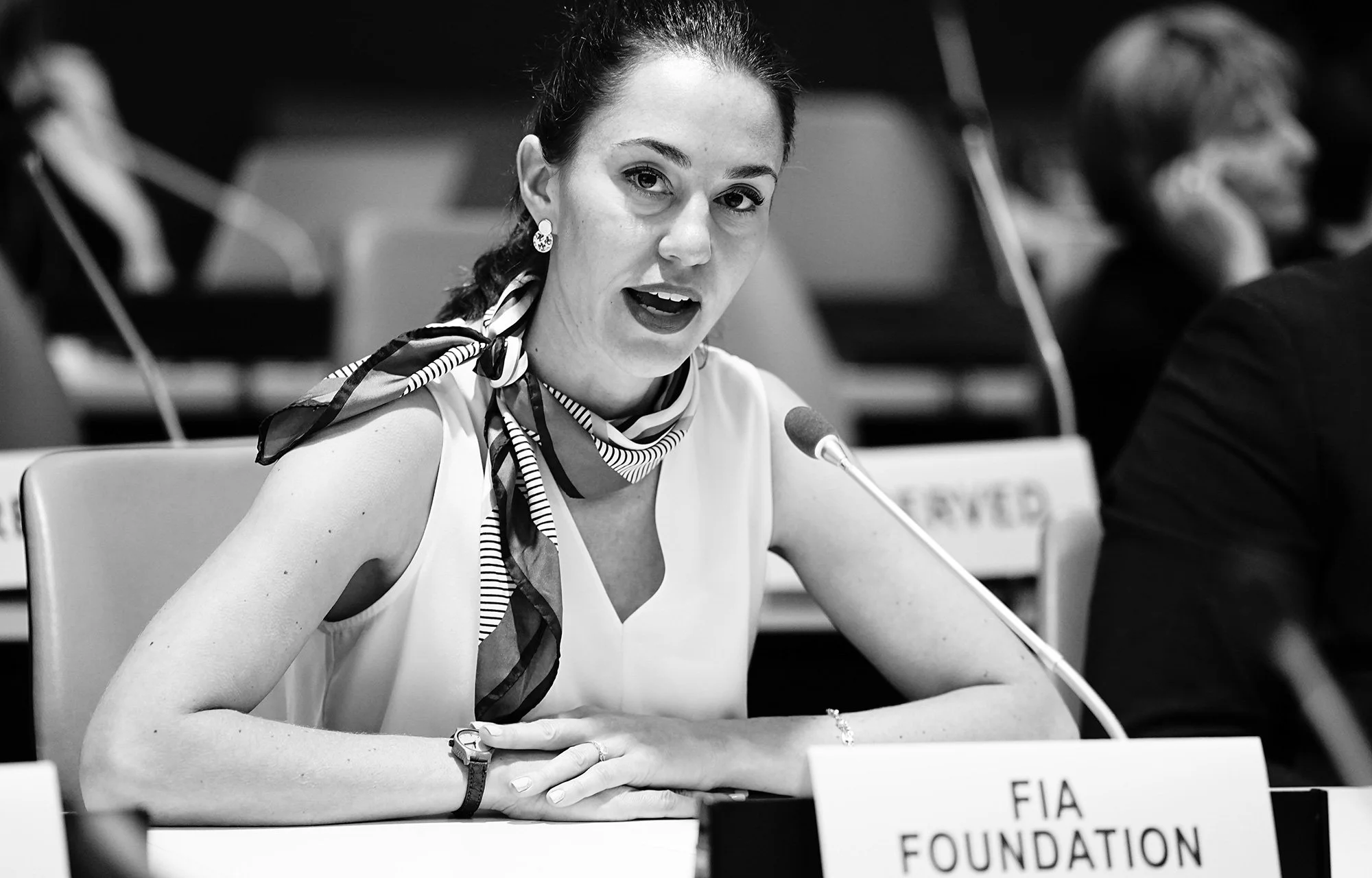
Global NCAP is proud to launch Women in Safety, a new editorial series celebrating the women whose leadership, expertise and determination are shaping the future of road safety. To open the series, we could think of few better guests than Natalie Draisin.
As Director of the FIA Foundation's North American Office and its UN Representative, Natalie has spent more than a decade at the forefront of the global road safety movement. When conversations amongst stakeholders are often dominated by the scale of the challenge ahead, Natalie is the steadfast voice of realistic optimism the room can count on to remind us of just how far we have come and why we must keep striving forward.
In this interview, Natalie reflects on the outcomes of the UN High-Level Meeting in New York where she and the FIA Foundation played a pivotal role, including as co-hosts of Global NCAP's first Forum for Safer Mobility. She shares why Intelligent Speed Assistance could become one of the decade's most transformative safety interventions, why accountability must now take precedence over ambition and what it will take to maintain the momentum needed to halve road deaths and serious injuries by 2030.
Global NCAP: What was your key takeaway from the UN High-Level Meeting in New York?
Natalie: “We can be hard on ourselves because we are determined to save more lives - as we should be - but something is definitely working. It's important to take a moment to recognise that. I think back to 2015, trying to convince over 100 UN Missions to support SDG 3.6 for road safety. It wasn't always easy and it wasn't always on their agenda. But if you fast-forward to the recent UN meeting, 162 countries showed up to vote for the Progress Declaration. That progress is telling. It means that we have more work to do, but we’ve secured a global movement to build upon. Now the question is how do we translate commitment to action and how do we keep that movement going? Because we're only halfway through this second Decade.”
Global NCAP: As we settle into the second half of the Decade of Action, what should be the world's top priority for accelerating progress?
Natalie: “I’ll focus on what is timely, feasible and has tremendous payoff - Intelligent Speed Assist (ISA). ISA is technology that helps drivers slow down and make good decisions. ISA has a multiplier effect, enabling other safety technologies like AEB and DMS to work more effectively. With our partners Global NCAP and Families for Safe Streets, we held a side event highlighting ISA’s unprecedented progress. To meet the goals of the Decade of Action, we have to see ISA grow on a global scale to the extent that it has grown domestically here in the US.”
Global NCAP: So far, has the adoption of ISA largely been confined to Western nations?
Natalie: “Yes. New York and London put ISA in their fleets and the EU passed a mandate. Several US states also passed Super Speeder Bills. But 90% of fatalities on roads occur in low and middle-income countries, which deserve to benefit from this protection as well. That’s why the FIA Foundation, together with Global NCAP, the FIA Club, a supplier and the local government, are going to pilot this in Bogotá, Colombia, as a starting point to reach more communities where there is so much opportunity to save lives.”
Global NCAP: What is the biggest barrier to scaling ISA both in low and middle-income countries and in the US?
Natalie: “To understand barriers, it’s helpful to first focus on what led to accelerated adoption. Our excellent partner Tom DeVito at Families for Safe Streets and I wrote an article about this. The ISA journey didn’t re-invent the wheel, it built upon lessons learned from ignition interlock device advocates that have banded together to promote ISA as well. The right mix of partners is key - and they were in the room at our side event in New York. From the New York Department of Citywide Administrative Services piloting this in their fleet, to the Insurance Institute for Highway Safety bringing the technology to consumers, they are working together tirelessly to get the message right, to overcome barriers through fearlessness, political will and framing. When you look at the messaging here in the US, there's something in it for both the political left and right who are behind this for different reasons. The Super Speeder bill in New York Citypassed in part because it's a bipartisan act which is remarkable in this very polarised political time. Those lessons can be applied anywhere in the world and particularly in low and middle-income countries which are suffering disproportionately from the burden.
“From that side event, it was easy to pinpoint barriers, the first of which is knowledge of ISA and understanding that it’s attainable. It’s powerful to hear from New York that it’s fairly simple to install. After knowledge comes the political will to implement it. And then there’s cost. It's not that expensive but cost is always an issue. New York was fortunate in that they applied for federal funding to install it into their fleets. But in low and middle-income countries, cost will be more of an issue. That's why these pilots are really important to prove the business case for ISA.”
Global NCAP: One criticism of ISA is that it is too interventionist. How significant is that challenge?
Natalie: “In the US, it's not as much of an obstacle as you might expect. Part of that, again, goes back to the bipartisan approach. Some might view Super Speeder bills as targeting the ‘bad guys’ - the worst offenders. Others might say ISA helps the mom who was caught speeding to pick her kid up from school - she can keep her license so she can drive him to soccer. There’s something in it for everyone.”
Global NCAP: The FIA Foundation was a founding partner of the UN Road Safety Fund which held the Partnership Pledging Conference in New York. How has the Foundation shaped the Fund and its impact over the past decade?
Natalie: “When the fund was established, the FIA Foundation was in the privileged position to make an initial commitment of $10 million. We believed that there was a need for a UN-based global mechanism that could bring partners together around evidence-based solutions and help countries deliver interventions that save lives.
“It's really encouraging to see how that vision has grown. Our priorities at the FIA Foundation align very closely with the work of the fund and we've seen the benefits. In Rwanda, our complementary investments through the Tuwurinde programme helped establish a new national helmet standard and Africa's first testing laboratory. The fund's investment in the Safe and Affordable Helmets Initiative helped advance our shared commitment to ensuring that protective equipment isn't just available but also meets internationally recognised standards. The fund's also helping to scale proven approaches to school safety, building on tools like our partner iRAP Star Ratings for Schools. All of those partnerships are the things that we need more of. Rather than working in parallel, we build on one another's strengths, connect investments and ensure that evidence and policy implementation move forward together.”
Global NCAP: One of your key messages at the High-Level Meeting was that promises are not enough and we need accountability. What does accountability look like?
Natalie: “At the ‘Commitments in Action Roundtable: Multistakeholder Accountability for Safer Roads’ official side event, which we co-hosted with the Global Alliance of NGOs for Road Safety, iRAP and the African Road Safety Observatory, I began by asking people to think back to where we stood at the Decade’s start. We didn't have commitments like we were hearing at that table. Now we can fill a room at the UN with governments and civil society and industry leaders. That's remarkable. But we also know that commitments don't actually save lives; accountability saves lives. This means following best practices, implementing actions and measuring results and that’s what this session was about. It was about the Progress Declaration that Member States adopted that reaffirmed the target of halving road deaths and injuries by 2030, and it was about the fact that the Progress Declaration doesn't just ask us to make promises. It asks us to show our work.
“A growing number of countries have dramatically reduced their deaths on roads. But still, more than one million people are dying on the world's roads every year and road traffic injuries are stubbornly the leading killer of children and young people. Behind every one of those numbers is a journey that should have ended safely at home and a community that's waiting for the promises made in rooms like that one to reach their streets. The takeaway was that the second half of this Decade is not going to be delivered in New York. It’s going to be delivered in ministries, city halls, communities, and boardrooms, by the people in that room and those who weren't - often NGOs on the ground that have been driving this since the start.
“We can’t let those voices go unheard. Women in particular must have a seat at every table. Our lived experience is different. We know what it’s like to grip our children’s hands as cars speed past on the walk to school, to take the bus even when it feels unsafe because private vehicles are too expensive, and to suffer more injuries than men in crashes because the world wasn’t designed for us. Our work is far from done but when we are heard, everyone benefits.”
Global NCAP: Looking ahead, how must the global strategy in the second half of the Decade differ from that of the first?
Natalie: “Road safety must be integrated into a wider agenda. Conversations in this echo chamber won’t cut it. We must integrate road safety into public health, environment and corporate agendas. Around one-third of the people who die on the world's roads are commuting to and from work, or or at work. Here in the US it’s higher - around 38% - and the leading cause of death in the workplace. This means an opportunity for corporations to take the lead.
“Think about the environmental movement - rewind 15 or 20 years ago when we were still drinking out of plastic straws and using plastic bags. When you booked a flight or an Uber, it didn’t tell you what your carbon footprint was. That changed in part because the private sector recognised the environment as their responsibility. We could see the same progress with safety. On Google maps or in your rideshare, you could follow the statistically safest route. You could have your packages delivered by whatever delivery service kills the least number of people on the road. One way that we galvanise organisations to take the lead is through the FIA Driver Safety Index which uses AI and real-world driving data to help improve safety. Their Road Safety Index is also a powerful tool, helping organisations assess their safety footprint, much like a carbon footprint, over their entire value or supply chain.”
Global NCAP: Who is one woman in safety that inspires you the most and why?
Natalie: “There are many. And many of them have been mentored by Sue Baker, the mother of injury prevention. Sue became my mentor after a friend was tragically killed by a drunk driver. Afterwards, Sue asked me her signature question, "What are you going to do about it?” She is a quiet pioneer. She might be one of the reasons why you buckle your seatbelt, wear a helmet, or slice your kid's hot dog lengthwise so they don't choke on it. Most people don't know her name but she is a large part of why we take modern safety for granted.
“What’s changed since I met Sue - and why I’m writing a book about her now - is that safety is quietly being taken away from us. It took decades to build the federal scaffolding that keeps us safe. Here in the US, from the Centers for Disease Control and Prevention to the National Highway Traffic Safety Administration, safety is being dismantled. We may not notice until it's too late. That’s why Sue has agreed to finally tell her story. Her path from 36-year-old stay-at-home mom to public health heroine was unlikely, but replicable. The field’s survival, and ours, could depend on her roadmap. I’m loving the process of writing this book with her, and I’m learning a lot. Currently, I’m seeking a literary agent. Sue is 96 and my dream is to hand her this book about her life’s work, a small thank you for all the lives she’ll never know she saved.”