Don’t wait for legislation: Euro NCAP urges truck and trailer manufacturers to act on rear underrun protection
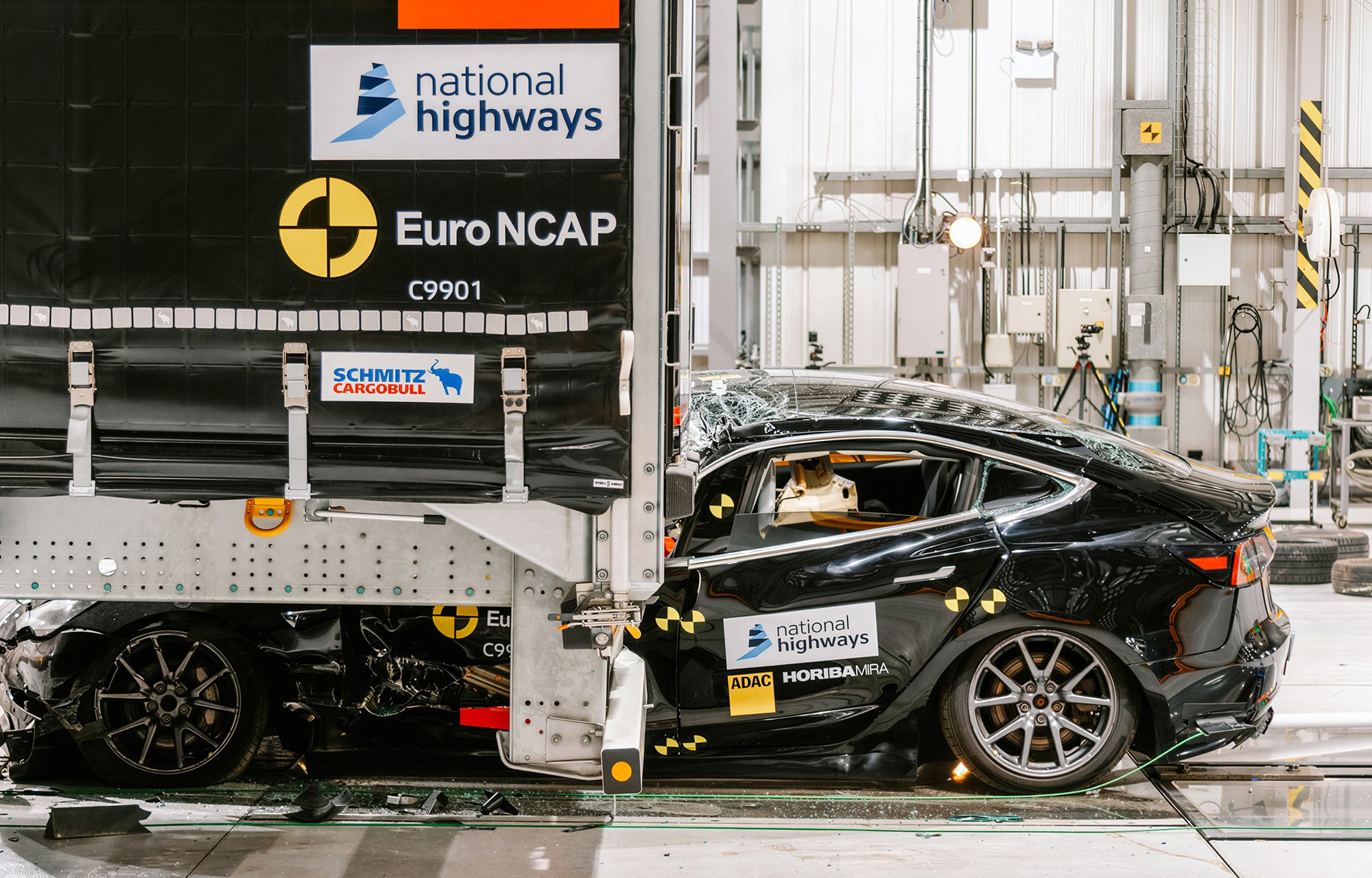
Euro NCAP is urging truck and trailer manufacturers to take immediate action on rear underrun protection.
Rear underrun collisions happen when a passenger car impacts the back of a heavy trailer and slides underneath it. The trailer bed acts like a guillotine, impacting the passenger compartment and bypassing the car's engineered crumple zones and restraint systems.
The call for action comes after hard-hitting research from the vehicle testing body found that critical vulnerabilities in current systems contribute to an estimated 400 fatal trailer rear underrun collisions in Europe every year. This is despite European trailer guards being built to the current mandatory UN standard.
Now, Euro NCAP is calling on truck and trailer manufacturers to voluntarily make upgrades and retrofit proven solutions to improve rear underrun protection - and to not wait for legislation to mandate it.
“We applaud the next step conversations in the UNECE working groups. But legislation should set the floor, not the ceiling,” said Euro NCAP Director of Strategic Development Matthew Avery.
At the 132nd session of the United Nations Economic Commission for Europe (UNECE) Working Party on General Safety Provisions (GRSG) currently ongoing in Geneva, Euro NCAP will present its test findings to global vehicle regulators and call for an urgent regulatory review.
The GRSG is a subsidiary of the World Forum for Harmonisation of Vehicle Regulations (WP.29) which prepares draft regulatory proposals on general vehicle safety. In Geneva, Euro NCAP will set out how the equivalent underrun protection advocated in the US by the Insurance Institute for Highway Safety-Highway Loss Data Institute (IIHS-HLDI) is significantly more effective than those in Europe, reducing the likelihood of these crashes from becoming deadly.
Recap: What Euro NCAP’s testing found
In June, Euro NCAP exposed critical vulnerabilities in rear safety guards on masses of trailers and trucks operating across the EU and UK.
Rear impact guards, also known as Rear Underrun Protection Systems (RUPS), are physical safety features that act as a low-slung barrier to prevent smaller vehicles from sliding underneath a truck’s frame during a rear-end crash.
Euro NCAP tested these rear impact guards alongside crash avoidance technologies during physical impacts. The testing was supported by the UK's National Highways and Department for Transport, alongside international partners including Germany's ADAC, Sweden's Trafikverket and the US Insurance Institute for Highway Safety (IIHS).
When crash-tested at 56 km/h (35 mph), European trailer rear guards built to the current mandatory UN standard were found to fail structurally. The guards buckled, meaning even five-star rated passenger vehicles were prone to sliding underneath and suffering fatal damage.
Vehicles equipped with early-generation Advanced Driver Assistance Systems (ADAS) successfully detected standard laboratory targets every time but detection rates dropped significantly when facing real commercial vehicles like skeletal or curtainside trailers. As the average age of passenger cars continues to rise, Euro NCAP warns that it will take more than 15 years for crash-avoidance technology to significantly mitigate the issue.
In a comparative assessment, Euro NCAP performed the same testing but this time against trailers with rear underrun barriers built to the voluntary US IIHS TOUGHGUARD benchmark. The rear guard held firm under identical impact conditions, resisting the energy impact and enabling the passenger car’s front crumple zones and airbags to deploy as intended, protecting occupants.
Euro NCAP therefore calls for European trailer specifications to be modified accordingly, arguing that the IIHS US benchmark offers a blueprint for helping tackle these deadly collisions. Upgraded underrun protection must be rapidly phased into commercial truck and trailer fleets, the body states, just as ADAS features are being phased into consumer cars.
But crucially, the industry does not need to wait for regulation to mandate this. The solutions are proven and available. Regulatory updates can take years. Voluntary action will not only help prevent hundreds of deaths across Europe but it will demonstrate which manufacturers are prepared to lead by example.
“We know why these fatalities happen and thanks to the IIHS leading voluntary solution already adopted in the US, we know how to fix them. We are calling on European trailer builders and heavy transport fleets to step up now,” said Avery.
“There is no reason to wait for legal mandates when simple, voluntary changes to trailer rear guard designs can start saving lives on our roads immediately. This is a real opportunity for industry to prevent deaths on European roads and meet Vision Zero targets.”