Women in Safety with Becky Bavinger
When Becky Bavinger was 17 years old, she was driving to high school one morning when the driver of the lorry on the other side of the road fell asleep at the wheel, crossed over the middle and crashed into her head-on.
Becky was lucky. The airbags of her car deployed, the speed travelled was 40mph and she walked away with six months of physiotherapy ahead of her but no major injuries.
“I was in the U.S. and I had a car that met U.S. safety standards,” Becky tells Global NCAP.
A young girl dreaming of Broadway at the time, Becky didn’t know that public health would eventually become the heart of her work and that she’d grow to be one of the loudest voices for global road safety.
But here we are - Becky Bavinger of Bloomberg Philanthropies, one of the world's biggest powerhouses for road safety. Fourteen years into the job, she sits down for Global NCAP’s ‘Women in Safety’ editorial series to share her journey into road safety and her relentless strive for safer speeds and safer vehicles for the people of low and middle-income countries who still to this day cannot rely on the same protections she had that morning on her way to school.
Global NCAP: Can you tell us about yourself and how you got into road safety?
Becky: “So I actually always dreamed of being on Broadway. I was doing theatre and dancing but then I had a car crash when I was 17 in high school. It took me out for a few months to do physical therapy and when college came I pivoted. I thought, okay, let me do theatre for fun but I want a career in international relations.
“After college, I went to live in India for three years in Kolkata where I worked for a women’s rights social enterprise and I absolutely loved it. But I still wanted to work in higher level policy so I came back to graduate school in New York and got a Master’s in Public Administration. I had women’s rights and economic development in mind but then I received an email about a temporary opening at Bloomberg Philanthropies. I didn’t know anything about public health other than it’s good. But I applied and I started working as a temporary hire for someone on parental leave. That was back in 2012 and now I have been here for 14 years and I absolutely love it. I’m on the Public Health team and we support programmes mostly in low and middle-income countries. My portfolios are road safety, drowning prevention and tobacco control, with most of my time spent on road safety and drowning prevention.”
Global NCAP: Can you tell us more about your car crash? Do you reflect on this during your road safety work today?
Becky: “I reflect on it in the sense that I feel very fortunate. I was driving to school in a Toyota RAV4 which is a smaller SUV model. It was early morning and the driver of a semi trailer - we call them 18-wheeler trucks - had fallen asleep at the wheel and he ended up crossing the median and hitting me pretty much head-on. But because I'm in the U.S. and had a car that met our U.S. safety standards, there were airbags that deployed and the vehicle frame stayed intact so I walked out with injuries but nothing major. I fully recovered in six months.
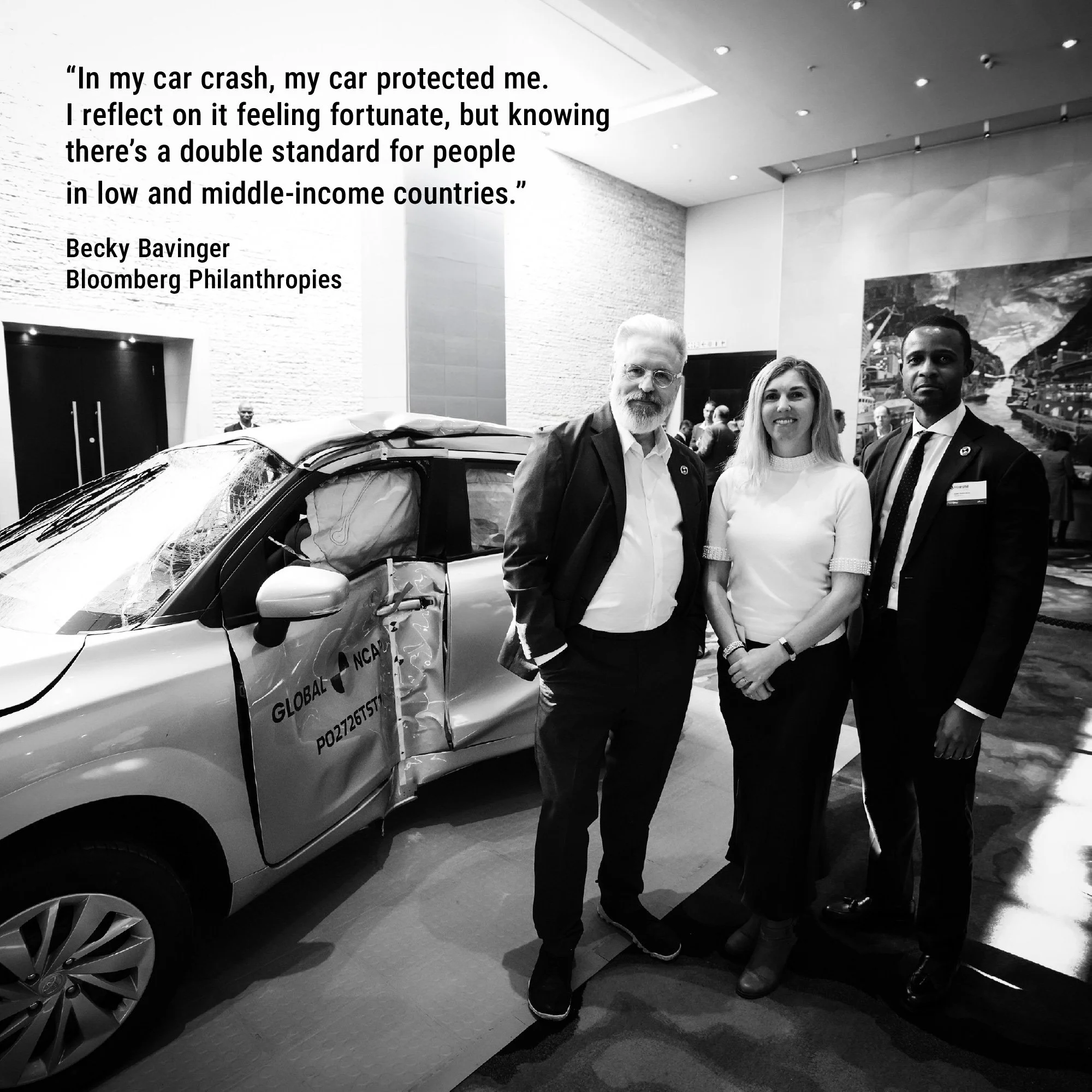
“In my car crash, my car protected me. I reflect on it feeling fortunate, but knowing there’s a double standard for people in low and middle-income countries who don’t have that as a standard. The standard that the base model of a car you’re going to buy has all of those safety features to protect you. That definitely keeps me motivated to work on the vehicle safety side of road safety. The other aspect is speed. Fortunately, we were both going at about 40 miles per hour. In other countries, speeds are much higher on those kinds of roads. In the U.S., there was speed management and that gave me another protection that day.”
Global NCAP: Expanding vehicle safety is one area to be funded by the recent $350 million investment for the Bloomberg Philanthropies Initiative for Global Road Safety. What will this action look like in practice?
Becky: “It’s largely a continuation of the work we’ve been supporting Global NCAP to do since 2015, which is to serve as an independent testing authority in markets that don’t have access to that. We’re going to continue supporting their work in Latin America, Africa through their Safer Cars for Africa programme, India through Safer Cars for India, and also in Southeast Asia.
“We’re also working with Global NCAP as they upgrade the safety protocols in some regions to include pedestrian protection. NCAP protocols have traditionally measured the car’s ability to protect the occupants of the car, both adult and child, but we know that cars often collide with vulnerable road users like pedestrians, cyclists and motorcyclists. This is something Global NCAP is pushing for, like Euro NCAP and Australasian NCAP which have had pedestrian protection in place for years.
“Another area we’re focused on, particularly in Africa, is secondhand vehicle imports which often come from the US, Europe and Japan. The recommendation from NCAPs and the WHO is to have an age cap so that countries can’t import cars that are so many years old. Vehicles need to meet a maximum age cutoff so that they can capture the same safety standards that have been adopted in the countries exporting to African countries.”
Global NCAP: You spoke of an age cap for vehicle imports at Global NCAP’s Forum for Safer Mobility in Cape Town this month. Can you share more on what you discussed?
Becky: “Yes, we work really hard on this “double” approach to improve vehicle safety. So this is making consumers aware of the car model’s safety features before they buy a vehicle and pushing manufacturers to voluntarily improve their fleets. But it’s also requiring governments to mandate that these safety features are complied with and regulate the maximum age cut-offs for imports.
“Two things stood out to me from the Forum in Cape Town. First, youth voices are going to be critical, especially in Africa where youth make up a huge proportion of national populations. Young people are amongst the most severely affected by road traffic incidents and having their voice advocate for road safety will be critical. Second is fleet safety and trying to get private companies who have a huge fleet footprint - but also government fleets - to adopt a five-start minimum standard. If the public and private sector only purchase cars that meet this standard, this will create demand to make those vehicles available. It will also improve the national fleet much quicker than if we only rely on each passenger car sold to meet the five-star minimum.”
Global NCAP: How can the road safety industry engage more youth voices across Africa?
Becky: “There's a great organisation called YOURS - Youth for the Road Safety - that we are bringing on as a partner as part of the $350 million investment. We’ll be working with them to recruit youth advocates, which is something they’re doing already, and supporting them to participate at the city and national level, attend councils and hearings and be part of civil society consultation for government policy. We train them to be spokespeople and talk with journalists and media to continue pushing road safety onto national political agendas.”
Global NCAP: Cape Town is one of the latest cities to join the Bloomberg Philanthropies Initiative for Global Road Safety. What do you think is a unique challenge the city is suffering with that may not apply to other cities across Africa?
Becky: “I'm having a hard time figuring out a unique problem because when we met with the city we were presented with data that unfortunately seemed all too familiar. Nearly 70% of their road fatalities are pedestrians. Speed is a huge contributor. There's an increasing use of motorcycles both for taxis and delivery apps with riders at risk, and the majority of deaths are not in the city centre but on roads with higher speeds coming in and out of the city. These are concerns we’re seeing not just in Africa but elsewhere too. A high concentration of pedestrian and motorcyclist fatalities and high speeds.
“One area I think Cape Town is doing a better job than others is investing in public transportation. The safest way to move in cities is taking the bus, metro or light rail. We’re trying to get more cities to make those investments and help shift transport out of private vehicles and onto public transport and then active mobility like walking and cycling. So I’m not sure what the unique issue is for Cape Town, but the city is certainly unique in its political will and commitment, and the City Council has just approved its first Road Safety Strategy which positions them to make progress.”
Global NCAP: How will Bloomberg Philanthropies work with Cape Town to implement the Road Safety Strategy?
Becky: “We’ll be working with the city on comprehensive speed management and investing in pedestrian and cycling infrastructure. It’s not enough to have those old pedestrian bridges that many cities in Africa have which don’t work in an urban setting. We need wide footpaths and elevated crosswalks that reduce the speeds of vehicles approaching before they interact with pedestrians. We’ll be pushing for this across all of our cities.
“Our funded partners are working with the city to identify specific activities within the strategy that they can support. It’s very much a city-driven programme and we want to support their plans and targets. It’s being mapped out right now and the partnership will last for five years, which started in September this year.”
Global NCAP: What will success look like in Cape Town?
Becky: “Ultimately, we want to reduce the number of crashes, deaths and serious injuries. We work with the city on the data side to support data strengthening but also to ensure it’s timely - a lot of the time there’s a long lag in synthesizing data. So we're working with the city's public statistics offices and police on crash reporting to improve the quality of data to demonstrate if we’re having an impact on reducing serious crashes. We’re also working with Johns Hopkins University who will be selecting local universities to collect risk factor data. That work will see people go on the streets and track speed rates, drinking and driving rates, helmet wearing and seat-belt wearing. Reduction in speed is one way we can measure success but ultimately it’s how many deaths and injuries can we prevent?”
Global NCAP: As the world works towards the UN Decade of Action goal of halving road deaths and serious injuries by 2030, what do you think is the key priority for action?
Becky: “Speed. I think the world has done a really good job at denormalising drinking and driving. Most people understand that drinking and driving and driving under the influence of drugs is a risk. I don't think we've achieved that yet for speed which causes over half of all road fatalities. Through all of our work and partnerships, we try to focus on speed management. That’s everything from design like speed humps to automated cameras, mobile enforcement and media campaigns, all working to get speeds down to safe levels when interacting with pedestrians and cyclists."
Global NCAP: Who is one woman in road safety that inspires you and why?
Becky: “That's going to be Sylviane Ratte. She's the Director of Road Safety at Vital Strategies and she is a powerhouse. There's nothing this woman can't do. She comes from tobacco control in France which was a really tough environment when she started and she is just relentless. She gets governments to make investments in road safety. She can move mountains. When it comes to making governments truly understand the importance of road safety, she is just a dynamo.”