WHO reports road safety progress as global leaders adopt new Declaration
The World Health Organisation (WHO) has released a progress update in reducing the rate of road deaths across the world.
Between 2011 and 2025, WHO data reveals that the global rate of road traffic deaths fell 21% while the total number of road traffic deaths fell by 9%. The progress comes as more than one billion motor vehicles entered the global street circulation during the same time period.
WHO released the findings during the UN High-Level Meeting on Improving Global Road Safety in New York which united government officials, the private sector, philanthropic foundations and civil society to advance progress towards the global target of halving road deaths and serious injuries by 2030.
“This progress shows that change is possible when countries invest in safe road systems,” said WHO Director-General Dr. Tedros Adhanom Ghebreyesus. “In the last 15 years we’ve made real progress in reducing road deaths, despite surging vehicle numbers and major shifts in how people move.”
The progress is welcome, but it comes with a stark warning that the world still remains far off track to meeting the Decade’s 50% reduction target. In 2025, road traffic crashes still claimed 1.16 million lives while road traffic injuries remain the leading cause of death among children and youth aged 5 to 29 years.
World leaders renew pledge for action
The call to accelerate road safety action was heard.
Kicking off the UN meeting, world leaders adopted a new Declaration to accelerate progress towards the 50% reduction target. The Progress Declaration passed with overwhelming support by a vote of 162-1, with the US the only nation to vote against it.
By terms of the Declaration, the General Assembly reaffirmed its target of halving road deaths and injuries by 2030. With the vote, governments committed to various actions including the establishment or designation of national lead agencies, funded national road safety strategies and aligning speed limits, road and land-use design, traffic rules and vehicle technologies.
Declaration spotlights role of NCAPs
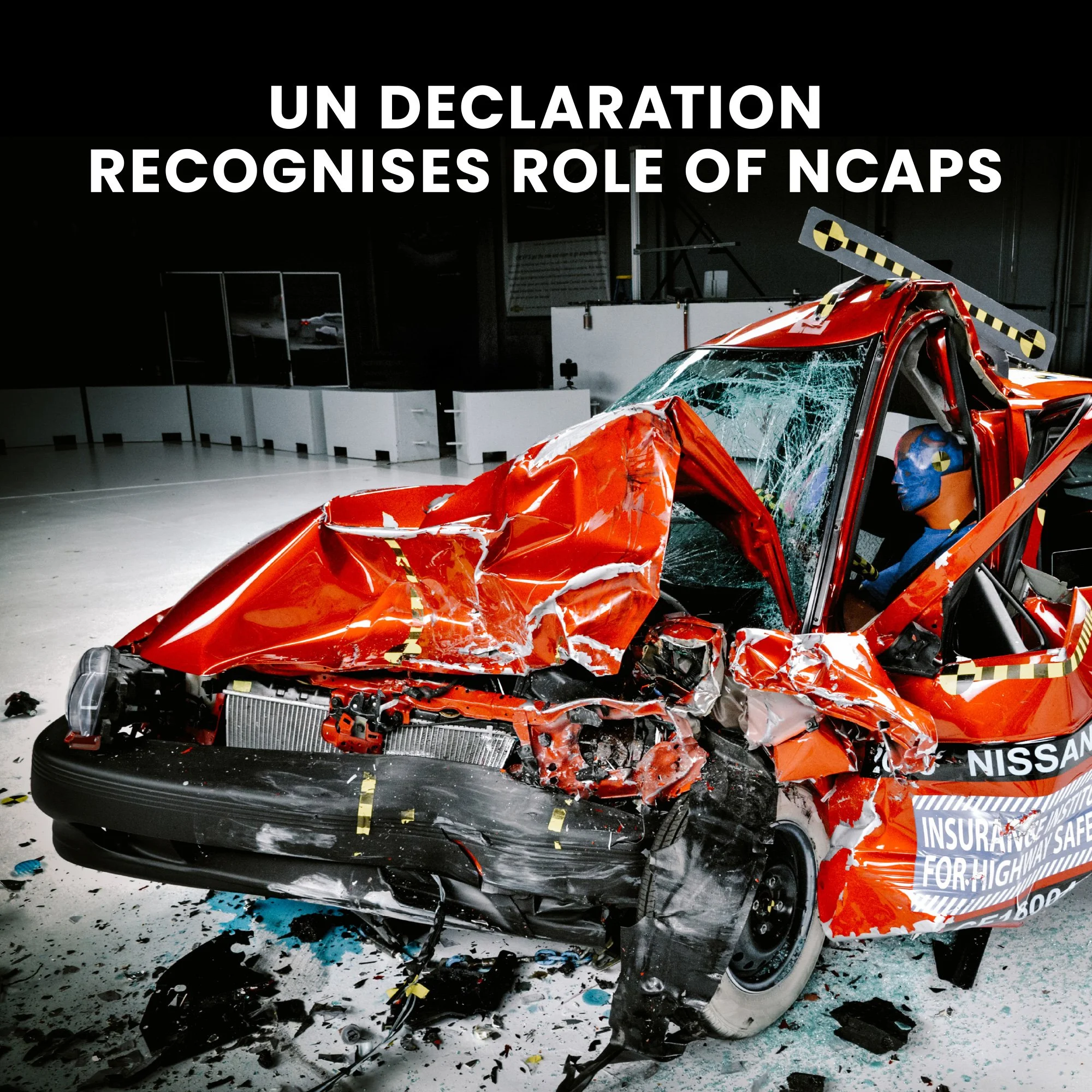
The Declaration pays tribute to the vital role that vehicle safety awareness has to play in accelerating road safety progress.
Action 24 commits nations to ensure that “vehicles provide a high level of safety performance including through consumer information, such as new car assessment programmes”.
Continuing on, the pledged action calls for control over used vehicle import and exports and the application of internationally agreed vehicle safety regulations, standards and best practices.
“The United Nations communique from attending Heads of State and Government high-level representatives recognises that NCAP-based consumer information programmes, along with regulatory standards, provide an essential push/pull effect on shaping markets for improved safety,” said Richard Woods, CEO of Global NCAP.
The Declaration’s spotlight on new car assessment programmes comes after bodies like Global NCAP have relentlessly advocated for vehicle safety technologies on the global stage and consistently pressured vehicle manufacturers to improve safety standards even when regulation doesn’t oblige them to.
Vehicle safety technologies again emerged as a cornerstone of the conversation at the UN’s interactive multi-stakeholder hearing on road safety earlier this summer which preceded the High-Level Meeting.
“The worldwide wave of motorised development has proved to be a weapon of mass destruction,” Global NCAP President Emeritus David Ward told the session, with more than 30 million lives claimed by road crashes in the past 25 years alone.
“If all the vehicles over those last 25 years had met best practice in vehicle standards, you could probably cut that number by between 25 and 30%. That gives you the scale of the improvement that the vehicle part of the story could contribute.”
The progress update from WHO is to be celebrated but we are far from where we need to be. Trustworthy consumer information is amongst the vital ingredients that are essential to democratising vehicle safety across the world, and Global NCAP welcomes the consistent institutional recognition of this on the UN stage.