Global NCAP urges South Africa to go further with proposed vehicle safety rules
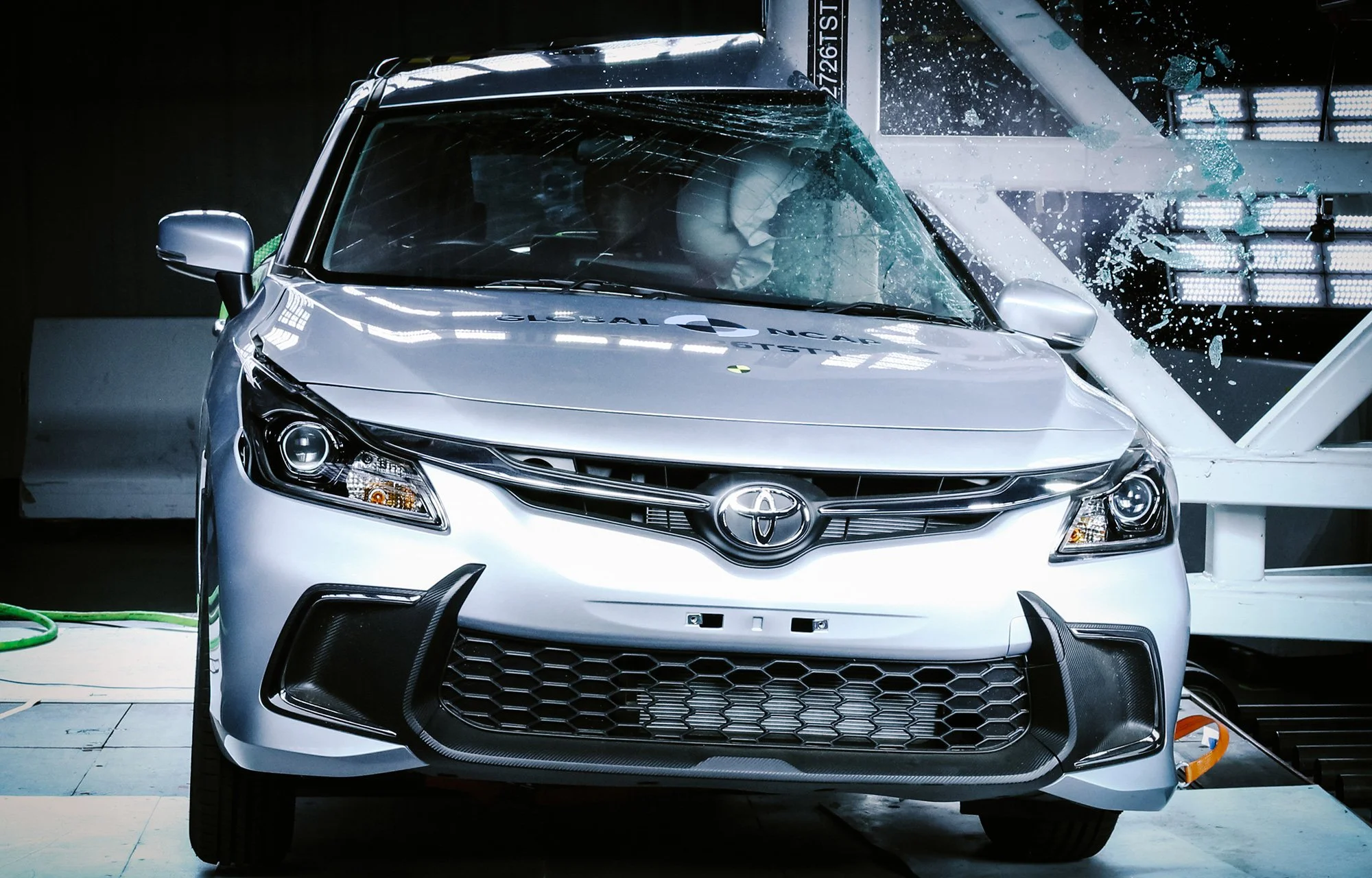
South Africa’s National Regulator for Compulsory Specifications (NRCS) has published proposed amendments to the nation’s vehicle regulatory standards.
The draft amendments to the Compulsory Specification for Motor Vehicles of Category M1 (VC 8022) aims to strengthen the minimum compulsory safety requirements for new passenger vehicles sold in South Africa. They apply to vehicles that can carry up to eight passengers plus the driver.
South Africa loses over 12,000 people to road crashes each year with pedestrians making up around 42% of those deaths. Global NCAP commends the NRSC for bringing this urgent draft specification forward but calls on the regulator to go even further with six recommendations shared as part of the consultation process.
What does the draft specification say?
Amongst the most crucial amendments proposed in the draft is to increase the minimum number of airbags to cover the driver and all occupants of the vehicle.
Side-impact protection is also stated as a requirement alongside frontal, rear-impact protection and steering-impact.
Electronic Stability Control (ESC) is accepted, with compliance to be in line with UN Regulation No 140 where a vehicle is fitted with ESC.
Advanced driver-assistance systems are also mentioned alongside Advanced Emergency Braking Systems (AEBs) autonomous vehicle functions and cybersecurity provisions.
The revised draft, according to the regulator, aims to both strengthen the minimum safety requirements for new passenger vehicles sold in South Africa while keeping the framework relevant as newer models such as electric, hybrid and alternative-fuel vehicles and those with newer technologies enter the market.
Global NCAP calls to go further
Global NCAP welcomes the move from the NRSC but believes the regulator must go further to protect its consumers.
In research that Global NCAP commissioned from the Johns Hopkins Bloomberg School of Public Health, it was found that up to nearly 15,000 South African lives could be saved by 2030 through implementation of the nine recommended minimum UN vehicle safety standards and Intelligent Speed Assistance (ISA).
The safety standards include seatbelts and anchorages, child restraints, motorcycle Anti-lock Braking Systems (ABS), frontal and side impact, pedestrian protection, Autonomous Emergency Braking, and Electronic Stability Control (ESC). ISA is being considered for global regulation.
Through full implementation of the nine standards and ISA, the research found that between 4,755 and 14,939 South African lives would be spared by 2030. This could rise drastically to between 74,761 and 188,106 by 2050.
A clear adoption gap is highlighted by the study. G20 countries with fatality rates above 12 deaths per 100,000 are less likely to have adopted the full set of standards.
South Africa sits well above that threshold.
Our recommendations
From the new findings, and from Global NCAP’s six #SaferCarsForAfrica results for vehicles in the South African specification that were published between December 2025 and June 2026, Global NCAP has outlined a series of recommendations to the regulator.
1. Make Electronic Stability Control and Advanced Emergency Braking System mandatory fitment
In the commissioned research, ESC was found to be South Africa’s single highest-yield standard, delivering more lives saved than any other device in the set. The draft states that UN R140 "is accepted" rather than requiring ESC to be fitted, and applies UN R152 only to vehicles already fitted with driver assistance systems.
Acceptance of a standard is not the same as a fitment requirement and a conditional application means the requirement reaches only those vehicles that would have complied anyway. We recommend that both ESC and Advanced Emergency Braking System (AEBS) be made mandatory on all new vehicles, with AEBS including pedestrian and cyclist detection.
2. Add UN R135 alongside UN R95 so that curtain airbags become the means of compliance
Clause 3.9 requires airbags intended to protect occupants other than the driver but specifies no number and no type. As drafted, it can be satisfied by a single passenger airbag. Every vehicle we have tested in South African specification in the past year lacked curtain airbags and side head protection is the specification gap most consistently limiting results. Adding UN R135 pole side impact protection alongside R95 would make curtain airbags the practical means of compliance. If R135 is not adopted, we recommend that clause 3.9.2 state the requirement for curtain airbags explicitly.
3. Apply the specification to every variant and to all first registrations
Entry grade vehicles carry the sales volume in South Africa and it is precisely those grades that are specified down. A requirement that reaches only new type submissions leaves the highest selling derivatives unreformed. We recommend the specification apply to every variant and grade and to all vehicles first registered after a fixed date, rather than only to new approvals.
4. Adopt a single 24 month compliance date
Clause 13.4.1 allows 18 to 24 months for new submissions and clause 13.4.2 a further 18 to 24 months for variants, giving a total transition of up to 48 months. On the evidence of our retest programme, manufacturers have upgraded South African specification within a single model year. A four year transition is longer than the market requires and would cost lives that the specification is intended to save. We recommend a single compliance date 24 months after final gazetting, applying to all vehicles.
5. Add pedestrian protection and seat belt reminders
The draft does not include UN R127 pedestrian protection or an explicit requirement for seat belt reminders. Given that pedestrians account for approximately 42% of South African road deaths, the omission of R127 is significant. We recommend it be added, together with explicit seat belt reminders for all seating positions.
6. Require star rating labelling at the point of sale
Consumers currently have no consistent way to compare the safety of vehicles on sale. Of the ten best selling passenger cars in South Africa in August 2026, results range from zero to four stars and four models have never been independently tested in African specification at all. We recommend that the specification require display of an New Car Assessment Programme (NCAP) star rating at the point of sale, placing the information where the purchasing decision is made.
We also recommend that these requirements are not limited to the M1 category, calling for equivalent requirements to be extended to VC 8024 for category N1 vehicles and VC 8023 for categories M2 and M3.
“Global NCAP supports the adoption of the draft specification and commends the National Regulator for bringing it forward. The changes we propose do not require new technology or new international agreement. Every measure recommended here is already regulated at UN level and already fitted to vehicles produced by manufacturers operating in South Africa,” Global NCAP CEO Richard Woods stated in the letter to the NRSC.
“The evidence indicates that full implementation could save up to 14,939 South African lives by 2030 and up to 188,106 by 2050. Adopting the specification with these strengthenings would make a material contribution to the President’s commitment to halve road deaths by 2030.”